Download GitHub Administration.GH-100.Actual4Test.2026-05-21.48q.vcex
| Vendor: | Microsoft |
| Exam Code: | GH-100 |
| Exam Name: | GitHub Administration |
| Date: | May 21, 2026 |
| File Size: | 259 KB |
How to open VCEX files?
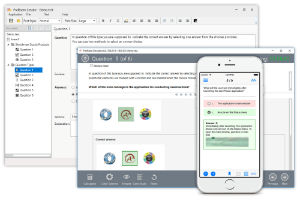
Files with VCEX extension can be opened by ProfExam Simulator.
Purchase
Coupon: TAURUSSIM_20OFF
Discount: 20%



Demo Questions
Question 1
When a user becomes a member of multiple GitHub organizations, which THREE of the following are important considerations for administrators? (Choose three.)
- The user will automatically have the same role across all organizations.
- The user's repository access and/or team membership needs to be managed separately for each organization.
- The user will need to authorize credentials separately for each SAML-enabled organization.
- The user will have different permission levels in each organization.
- The user's profile information becomes private to non-organization members.
- The user's personal repositories will become accessible to all organizations.
Correct answer: B, C, D
Explanation:
A user's repository access and team memberships are scoped to each organization, so admins must configure permissions separately per org.When an organization enforces SAML SSO, each member must authorize their personal access tokens or SSH keys for that org, requiring separate approval for each SAML-enabled organization Roles and permission levels (owner, member, billing manager, repository roles, etc.) are assigned on a per-organization basis, so a user often has different permissions in different organizations. A user's repository access and team memberships are scoped to each organization, so admins must configure permissions separately per org.
When an organization enforces SAML SSO, each member must authorize their personal access tokens or SSH keys for that org, requiring separate approval for each SAML-enabled organization Roles and permission levels (owner, member, billing manager, repository roles, etc.) are assigned on a per-organization basis, so a user often has different permissions in different organizations.
Question 2
What will happen if Dependabot discovers a vulnerable transitive dependency in a repository?
- It creates a pull request to update the direct dependency to a version that resolves the vulnerability.
- It opens a pull request to update the affected package directly, regardless of version compatibility.
- It automatically removes the package from the repository.
- It sends an email to the repository owner but does not alter code.
Correct answer: A
Explanation:
Dependabot will automatically open a pull request that updates the direct dependency to a version which, in turn, resolves (or removes) the vulnerable transitive dependency-ensuring the fix is applied via your declared dependencies. Dependabot will automatically open a pull request that updates the direct dependency to a version which, in turn, resolves (or removes) the vulnerable transitive dependency-ensuring the fix is applied via your declared dependencies.
Question 3
When comparing fine-grained Personal Access Tokens (PATs) with classic PATs, which of the following statements is accurate?
- Fine-grained PATs automatically renew while classic PATs require manual renewal.
- Fine-grained PATs permissions can be scoped to specific repositories.
- Classic PATs offer more permission controls than fine-grained PATs.
- Classic PATs can be restricted to specific organizations, but fine-grained PATs cannot.
Correct answer: B
Explanation:
Fine-grained personal access tokens let you scope permissions down to individual repositories, whereas classic PATs grant access across every repo the user can reach. Fine-grained personal access tokens let you scope permissions down to individual repositories, whereas classic PATs grant access across every repo the user can reach.
Question 4
You are using GitHub-hosted runners and need to securely deploy to an internal system. The security team requires that these runners use IP address ranges that would not be shared with other companies. Which of the following approaches would meet their requirements?
- GitHub-hosted larger runners with Azure private networking
- GitHub-hosted standard runners, using the IP addresses provided in "actions" from https://api.github.com/meta
- GitHub-hosted standard runners, using the IP addresses provided in "api" from https://api.github.com/meta
- GitHub-hosted larger runners with static IP addresses
Correct answer: D
Explanation:
GitHub's larger runners let you reserve dedicated static IP addresses for your workflows - so you can allow-list those IPs in your firewall and be sure they aren't shared with any other tenant. GitHub's larger runners let you reserve dedicated static IP addresses for your workflows - so you can allow-list those IPs in your firewall and be sure they aren't shared with any other tenant.
Question 5
A team member is unable to push to a repository due to a 403-error related to branch protection. What should the GitHub Enterprise administrator do first?
- Remove the user from the team and re-add them
- Check the user's permissions and rulesets applied to the branch
- Raise a GitHub Support request for permissions issues
- Revert the branch to an earlier state
Correct answer: B
Explanation:
The administrator should first review the user's repository role and the branch protection rules applied to that branch. A 403 error on push almost always indicates that the user either lacks the necessary write permissions or is not listed among the actors authorized by the branch protection settings. The administrator should first review the user's repository role and the branch protection rules applied to that branch. A 403 error on push almost always indicates that the user either lacks the necessary write permissions or is not listed among the actors authorized by the branch protection settings.
Question 6
Our organization is updating its enterprise policies. Which of the following steps should you take to ensure alignment with security requirements?
- Maintain clear documentation of existing policies and policy changes.
- Implement the new enterprise policies across the organization first and then consult with the security team to identify- any necessary adjustments or retrofits
- Implement changes without consulting stakeholders.
- Regularly assess and adjust policies based on evolving risks.
Correct answer: A, B
Question 7
You need to create a support bundle for your GitHub Enterprise Server instance with the hostname ghe.avocado.corp. What command should you use to create a support bundle?
- ssh -p 122[email protected]-- 'ghe-support-bundle -o' > support-bundle.tgz
- ssh -p 122[email protected]- 'ghe-diagnostics' > support-bundle.tgz
- curl -u admin https://ghe.avocado.corp/diagnostics/support-bundle.tgz -o
- ssh -p 122[email protected]-- 'ghe-config generate-support-bundle' > support-bundle.tgz
Correct answer: A
Explanation:
Run the ghe-support-bundle command over SSH on your appliance and redirect its output to a file. For example:ssh -p 122[email protected]-- 'ghe-support-bundle -o' > support-bundle.tgz This invokes the built-in support-bundle utility on your GitHub Enterprise Server instance and captures the resulting archive locally. Run the ghe-support-bundle command over SSH on your appliance and redirect its output to a file. For example:
ssh -p 122[email protected]-- 'ghe-support-bundle -o' > support-bundle.tgz This invokes the built-in support-bundle utility on your GitHub Enterprise Server instance and captures the resulting archive locally.
Question 8
What distinguishes Enterprise Managed Users (EMUs) from standard GitHub accounts?
- EMUs are fully controlled by an IdP and cannot log in with personal credentials
- EMUs can only be created using email invites
- EMUs are managed in GitHub and use GitHub authentication
- EMUs are only available for GitHub Enterprise Server
Correct answer: A
Explanation:
EMU accounts are provisioned and authenticated exclusively through your identity provider - users sign in via the IdP and cannot use or manage GitHub-native credentials. EMU accounts are provisioned and authenticated exclusively through your identity provider - users sign in via the IdP and cannot use or manage GitHub-native credentials.
Question 9
Which of the following is a key benefit of using GitHub Marketplace Apps in an enterprise?
- They guarantee no downtime during enterprise GitHub maintenance windows
- They often include integrations with external services, reducing the need for custom code
- Apps eliminate the need for GitHub Actions entirely
- All apps come pre-approved by GitHub's internal security team
Correct answer: B
Explanation:
GitHub Marketplace Apps come with built-in integrations to external services - so you can plug in things like CI servers, code-quality scanners, or deployment tools without writing and maintaining custom connectors. GitHub Marketplace Apps come with built-in integrations to external services - so you can plug in things like CI servers, code-quality scanners, or deployment tools without writing and maintaining custom connectors.
Question 10
What makes GitHub Apps a more secure choice for automation over OAuth Apps?
- GitHub Apps always require two-factor authentication.
- GitHub Apps can only be installed by organization owners.
- GitHub Apps are limited to read-only access and cannot write to repositories.
- GitHub Apps authenticate as an app with fine-grained permissions, not as a user.
Correct answer: D
Explanation:
GitHub Apps authenticate as themselves with fine-grained, installation-scoped permissions and short-lived tokens - rather than inheriting a user's broad OAuth scopes - minimizing blast radius and aligning with least-privilege principles. GitHub Apps authenticate as themselves with fine-grained, installation-scoped permissions and short-lived tokens - rather than inheriting a user's broad OAuth scopes - minimizing blast radius and aligning with least-privilege principles.
Question 11
An organization wants to share a single API key required for their Actions workflows. They need to restrict its use to only a subset of repositories. Where should they configure the secrets to minimize maintenance?
- Repository secrets
- Environment secrets
- Organization secrets
- Development environment secrets
Correct answer: C
Explanation:
By defining the API key as an organization secret, you centralize management and can grant access only to the subset of repositories you choose - eliminating per-repo duplication while enforcing the desired scope. By defining the API key as an organization secret, you centralize management and can grant access only to the subset of repositories you choose - eliminating per-repo duplication while enforcing the desired scope.
HOW TO OPEN VCE FILES
Use VCE Exam Simulator to open VCE files
HOW TO OPEN VCEX FILES
Use ProfExam Simulator to open VCEX files
ProfExam at a 20% markdown
You have the opportunity to purchase ProfExam at a 20% reduced price
Get Now!